
A lithium-ion battery can go from a strange smell to a room full of fire in less time than it takes to find a fire extinguisher. The same family of battery powers e-bikes, scooters, power tools, laptops, phones, and power banks, and the failure follows the same basic pattern in all of them. For the people in the building, the right response is to get out. For the people who have to sort out the loss afterward, the work is determining where the fire started, whether a battery caused it, and if so which battery, why it failed, and whether it was charging when it did.
A Living Room Lost in About 90 Seconds
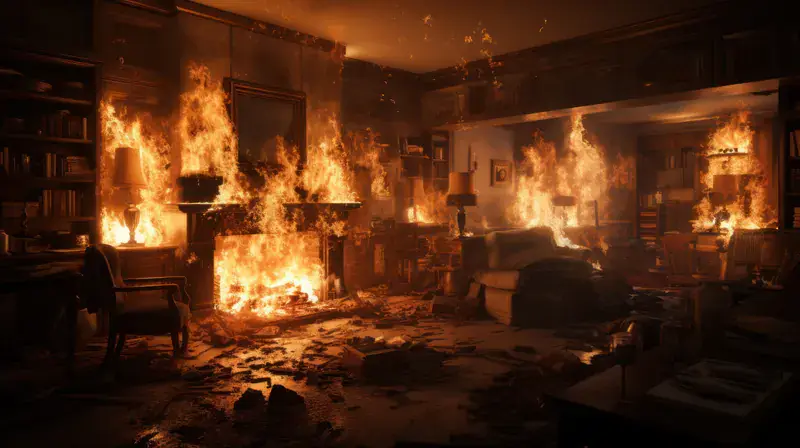
On the night of November 5, 2026, fire destroyed a two-story home in Troutdale, Oregon. Gresham Fire's fire marshal told KATU that investigators determined the cause was an e-bike battery that exploded while charging in the living room. Cameras inside the house recorded it, and the family posted the footage. Pat, a firefighter and mechanical engineer who runs StacheD Training, walks through it in E-Bike Fire Caught on Camera: Never Buy a Lithium-Ion Fire Extinguisher.
The sequence is worth watching closely. The occupants first notice an odor and walk the house looking for it. They do not find the source. The battery then goes from releasing smoke to violent fire with almost no transition. By his count the battery itself is finished burning in about 15 seconds, and the room is fully involved in about 90.
All six people in the house got out, according to Gresham Fire. A cat did not. Gresham Fire's battalion chief and fire marshal, Shawn Durham, told KATU that the footage "looks like fireworks mortars inside the living room." Crews arrived to heavy fire and no nearby hydrants, so water had to be shuttled in by tender.
Everyone was still awake. According to the video, three more e-bikes were upstairs, near the bedrooms. A few hours later, or one floor up, the outcome could have been very different.
What Happens Inside a Failing Battery
A lithium-ion battery pack is a group of individual cells. Each cell stores a large amount of energy in a small space. Inside, the positive and negative layers are kept apart by a thin plastic film called a separator. When a cell is damaged, overcharged, overheated, or defective, it can short internally or otherwise begin heating itself. Once that heating feeds on itself, the cell is in thermal runaway.
A cell in thermal runaway vents hot, flammable gas, and the heat it gives off can push the cell beside it into the same failure. Durham described it this way: "Once one starts on fire and starts to fail, it's an immediate reaction of the other battery cells in the area."
The amount of energy in the pack largely sets the size of the event. A phone holds one small cell. A power tool pack holds several. An e-bike pack holds dozens. UL Standards & Engagement reports that, in testing, an e-bike fire can fully engulf a room in less than 20 seconds.
It Is Not Just E-Bikes
E-bikes get the headlines because their packs are large and they are often charged indoors. The records show battery fires across nearly every kind of rechargeable device.
| Source | Period | What was counted |
|---|---|---|
| Oregon State Fire Marshal | 2020 to 2025 | 649 lithium-ion battery incidents statewide, rising from 74 in 2020 to 161 in 2025. More than half were in homes. |
| Gresham Fire (Oregon) | October 1 to early November 2026 | At least three home fires: one e-bike, one power tool, one laptop. |
| U.S. Consumer Product Safety Commission | 2017 to 2024 | At least 45 reported deaths in lithium-ion battery fires involving e-bikes, e-scooters, and hoverboards. CPSC says recent years are incomplete. |
| Federal Aviation Administration | 2025 | 93 verified incidents of lithium batteries producing smoke, fire, or extreme heat aboard aircraft. |
Sources: KATU, citing Gresham Fire and the Oregon State Fire Marshal; CPSC, Micromobility Products-Related Deaths, Injuries, and Hazard Patterns: 2017–2024; Lion Technology, summarizing FAA incident data.
The failure mechanism is the same across products. What changes is the specific chemistry inside the cells, how much energy is in the pack, how well the pack and charger were built, and where the device was sitting when it failed.
Other Recent Fires and Recalls Involving Lithium Batteries
Troutdale is not the only recent report. In each of the following, a fire agency, an investigator, or the Consumer Product Safety Commission has reported a rechargeable lithium battery as the cause or as a possible cause. One is still under investigation.
- Newberg, Oregon, October 2026. Tualatin Valley Fire & Rescue attributed a house fire to "a failure within a lithium-ion battery located on the back porch." According to the agency, the battery was not charging or in use. The homeowner and a firefighter had minor injuries.
- White House, Tennessee, November 2025. A family's home was a total loss after a fire at their back deck, where they had mounted decorative solar lights bought online. InvestigateTV reported that the product listing did not mention a lithium-ion battery. The city's fire investigator told the station there were no other ignition sources on the exterior of the deck that would have caused the fire. The insurer's forensic firm said the damage was too extensive to identify a specific component failure, and concluded the fire was "most consistent with a lithium-ion battery failure."
- Phone power banks. The CPSC re-announced a recall of about 429,200 Casely wireless power banks in April 2026. In August 2024 one caught fire on the lap of a 75-year-old New Jersey woman, who suffered second- and third-degree burns and later died from complications of her injuries. Another ignited on an airplane in February 2026. A separate September 2026 recall of NEWDERY power banks cites nine reports of units exploding and igniting, including one fire with $2 million in property damage.
- Rechargeable hand warmers. In July 2026 the CPSC recalled about 1.5 million OCOOPA hand warmers. The notice cites 1,480 reports of overheating, including 15 fires and 350 burn injuries, and one death.
- New York City, 2026. As of early November, FDNY had counted 406 fires caused by lithium-ion batteries this year, compared with 241 last year, according to Streetsblog. A November 5 fire in Sunset Park that killed six people is still under investigation by fire marshals. Early reports linked it to a lithium-ion battery, and it is not yet known whether a battery started the fire or was consumed by it.
One detail is missing from nearly all of these reports: the battery chemistry. "Lithium-ion" is a family, not one battery. The cells differ in what the positive electrode is made of (cobalt- and nickel-based blends, or lithium iron phosphate, written LFP or LiFePO4) and in how they are packaged (metal cylinders, rigid rectangular cases, or soft pouches, often sold as "lithium polymer" or LiPo). Pouch cells are common in phones, thin laptops, drones, and hobby packs. Cylindrical cells are common in e-bike and power tool packs, and in some laptops and power banks. Lithium iron phosphate is common in portable power stations, RV and solar storage, and golf carts. Fire department findings and recall notices rarely say what was involved. Identifying the cell type and chemistry is part of the laboratory examination, and it matters when the question turns to design and manufacturing.
The Warning Signs, and How Little Time They Buy
The National Fire Protection Association's lithium-ion battery guidance is direct: stop using a device if it feels very hot, starts to swell, smells strange, leaks, smokes, or makes popping or hissing sounds.
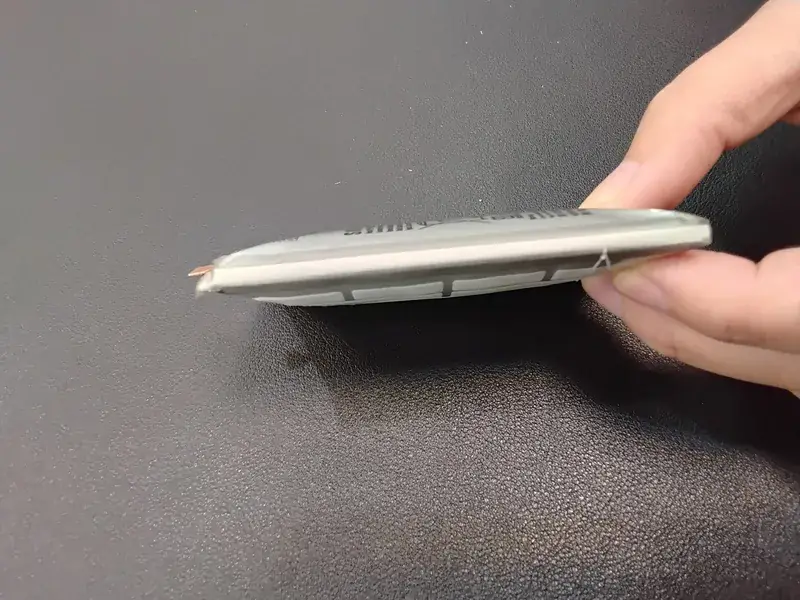
The smell deserves attention because it is often the first sign. In the Troutdale footage the occupants notice an odor before anything is visible. The likely source of an odor like that is electrolyte vapor venting from a cell. People often describe it as sweet, or like solvent. It may not smell like something burning, which is one reason it gets investigated instead of acted on.
Treat any of these signs as a battery that may be failing. NFPA's advice is to stop using the device, move it away from anything that can catch fire if it is safe to do so, and call 911. If it is smoking, hissing, or popping, do not pick it up. Leave it, get everyone out, and call 911 from outside.
Why a "Lithium-Ion Fire Extinguisher" Is Not the Answer
Extinguishers marketed for lithium-ion battery fires are easy to find. The video's advice is not to buy one, and the reasons hold up.
There is no U.S. rating behind the claim. Amerex, one of the largest extinguisher manufacturers, said in April 2024 that neither UL nor NFPA had put out a standard for lithium-ion battery fire extinguishers. As of November 2026 we found no UL listing category and no NFPA 10 classification for them. Two standards bodies outside the United States have moved: ISO 3941:2026 added a Class L for lithium-ion battery fires, and the European standard EN 3-11:2026 added extinguisher tests for small lithium-ion batteries. Neither is a UL listing or part of NFPA 10. In the United States, a label that says "lithium-ion" is not a UL or NFPA rating.
The fire skips the stage extinguishers are built for. Federal workplace rules define an incipient stage fire as one in its beginning stage that can be controlled with a portable extinguisher "without the need for protective clothing or breathing apparatus." A large pack in thermal runaway can pass through that stage in seconds. In the Troutdale footage it went from smoke to heavy fire with almost no transition.
The battery can be done before you get back. If the battery burns out in 15 seconds, the fire you return to is the couch, the carpet, and the walls. That is an ordinary room fire, and in the Troutdale footage it was beyond a handheld extinguisher within about a minute.
The smoke is toxic. Smoke from a house fire contains carbon monoxide. Burning lithium-ion cells add hydrogen fluoride. Researchers who exposed seven types of commercial lithium-ion batteries to an external fire measured 20 to 200 milligrams of hydrogen fluoride per watt-hour of nominal battery energy, and found that applying water mist did not significantly change the total released. Standing in front of that without breathing protection is how people get hurt.
None of this is a reason to get rid of a standard ABC extinguisher. It is still the right tool for a small fire that is just starting. It is not the tool for this one. When a battery fails, get everyone out, close the door behind you if you can, and call 911.
Reducing the Risk Before Anything Fails
- Buy listed products. For e-bikes, look for certification of the bike's electrical system (motor, battery, and charger together) to UL 2849. UL 2272 is the matching standard for e-scooters and hoverboards, and UL 2271 covers the battery packs for these vehicles. For everything else, look for the mark of a nationally recognized testing laboratory.
- Use the charger that came with the device. A charger that is not matched to the battery can overcharge and overheat it. Aftermarket chargers and packs appear repeatedly in CPSC's incident reports.
- Charge on a hard, flat surface, and unplug when the charge is complete. Beds, couches, and padded chairs trap heat.
- Do not charge unattended, overnight, or in an exit path. In a UL Standards & Engagement survey, 49% of e-bike riders who charge at home said they charge in a spot that blocks their way out.
- Charge and store large batteries outside the living space when you can. That includes e-bikes, scooters, and power tool packs.
- Inspect batteries, and retire damaged ones. A pack that has been dropped, crushed, soaked, or swollen should not be charged again. Do not put it in the trash or curbside recycling. Ask your local household hazardous waste program where a damaged battery can be taken.
There is still no federal requirement. In June 2026 the CPSC proposed a rule that would make versions of all three standards mandatory for micromobility products. As of mid-November 2026 it was still a proposal; the agency invited oral comments in October. Some jurisdictions have not waited: New York City has required certification to these standards since September 2023. In most of the country, an uncertified e-bike or replacement pack can still be sold legally.
Was It Charging? What the Investigation Has to Establish
In Troutdale, investigators reported that the battery failed while charging. That is the most common circumstance, but it is not the only one, and in a given loss it has to be established from the evidence rather than assumed.
The CPSC's 2026 proposed rule sorts the e-bike, e-scooter, and similar incidents it investigated into hazard patterns. Charging leads, but a meaningful share of fires started with no charger involved.
| Circumstance | Incidents |
|---|---|
| During normal charging | 120 |
| Stored or resting, not charging | 23 |
| During or shortly after riding | 18 |
| After charging, once unplugged | 12 |
Source: CPSC, Safety Standard for Lithium-Ion Batteries Used in Micromobility Products, proposed rule (June 24, 2026), "Hazard Patterns From the Incident Data." The rule lists further, smaller patterns not shown here.
Whether the battery was on charge changes which hypotheses have to be tested. A failure on the charger puts the charger, the battery management system, and the charging history in question along with the cells. A failure at rest does not clear those, but it turns more attention to the cells, the pack, and any earlier damage. The answer can change which companies have an interest in the evidence. Witness accounts of whether a device was plugged in are data, to be weighed with the physical evidence and the records.
The work follows the scientific method set out in NFPA 921: collect the data, determine where the fire started, develop each reasonable hypothesis for the cause, and test each one against the evidence. The battery is one hypothesis, not the starting assumption. Other ignition sources in the area of origin, including the building wiring and other appliances, get the same examination. If the evidence does not support one hypothesis over the others, the cause is undetermined, and that is a legitimate result. For a suspected battery fire, the questions include:
- Was the battery the cause, or a victim? A lithium-ion battery heated enough by a fire that started somewhere else can go into thermal runaway and burn. A burned battery in the debris does not by itself show where the fire started. The origin has to be determined first, and then the battery tested against the other ignition sources in that area.
- Which battery, and which cell? Many homes have several devices in the same area. Cells can be thrown from the pack and found across the room.
- Was it connected to power? The charger, its cord, the receptacle, and the charge port are examined for their as-found condition.
- Was everything original? Aftermarket packs, rebuilt packs, and mismatched chargers change the analysis and the list of interested parties.
- What is the product's history? Purchase records, prior damage, water exposure, repairs, and recall status all bear on why it failed.
Evidence That Must Be Preserved
Battery fire evidence is small, scattered, and easy to shovel out with the debris. Until an investigator has documented the scene, the safest course for an owner or adjuster is to leave things where they are, keep the area secured, and not plug in, charge, clean, or take apart anything. The items an investigation will want preserved, each photographed in place and tracked under chain of custody once collected, are:
- The entire device and battery pack, including every loose cell and cell fragment, with the location of each one documented before it is collected
- The charger, cord, power strip or extension cord, and the wall receptacle
- Other battery-powered devices and chargers from the same area, including those that appear undamaged
- Interior and doorbell camera footage, which is often overwritten within days
- Purchase records, order confirmations, manuals, packaging, and the seller's listing
- Any app, charging, or ride data tied to the device
- Photographs of the room before debris is moved
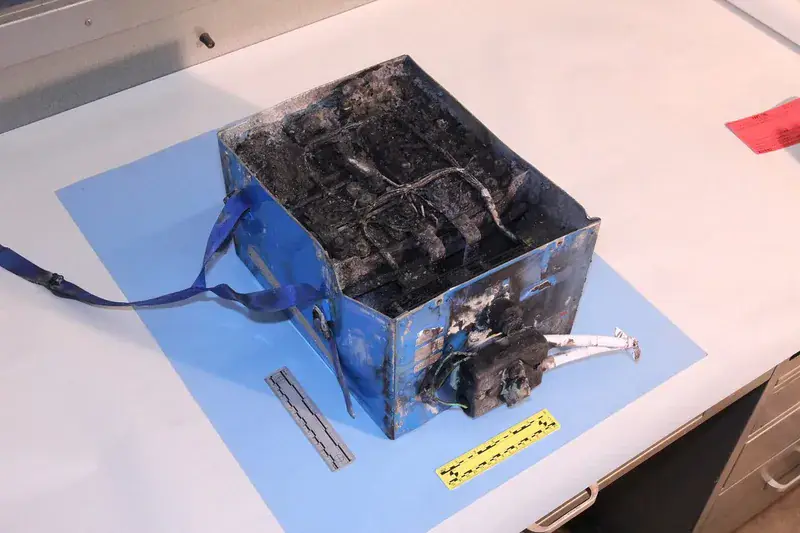
Cells and packs should not be taken apart at the scene. Once a product is suspected, the companies that may have an interest, such as the manufacturer, the seller, and the maker of the charger, should be put on notice as early as practical. Examination normally starts with nondestructive steps such as photography and X-ray or CT imaging. Teardown and other destructive work is ordinarily done at a joint laboratory examination, with interested parties given the chance to attend, under a written protocol agreed to in advance. Evidence that is lost or altered before the other side can see it can lead to a spoliation claim. Damaged cells can also reignite, so they need to be stored and transported with that in mind.
The steps for securing the scene and notifying interested parties are covered in detail in The First 72 Hours After a Fire or Explosion.
Scene Investigation and Engineering, Developed Together
LaRovere's fire investigations are led at the scene by Justin Weller. His background includes 13+ years in Arizona law enforcement, eight years in the fire service, and service as a hazardous materials technician. When the cause may involve a battery, a charger, or the electrical system that fed it, the scene work is paired with the firm's licensed Professional Engineers. The physical evidence and the engineering analysis are developed together and documented to the standard litigation demands.
Frequently Asked Questions
Why do lithium-ion batteries catch fire?
A lithium-ion cell stores a large amount of energy in a small space. If the cell is damaged, overcharged, overheated, or has a manufacturing defect, it can short internally and begin heating itself. That self-heating is called thermal runaway. The cell vents hot, flammable gas, and the heat pushes neighboring cells into the same failure. The more energy in the pack, the larger the fire can be.
Can a lithium-ion battery catch fire when it is not charging?
Yes. In the incident data behind its 2026 proposed rule for e-bike and e-scooter batteries, the CPSC counted 120 incidents during normal charging, but also 23 that began while the product was stored or resting, 18 during or shortly after riding, and 12 after charging had finished and the product was unplugged. Earlier damage, a defect inside a cell, or water exposure can lead to failure at rest. Whether the battery was charging is a question for the physical evidence, not an assumption.
Do lithium-ion fire extinguishers work?
As of November 2026 there is no UL listing category or NFPA 10 classification for lithium-ion battery fire extinguishers, so in the United States the claim on the label is not backed by a UL or NFPA rating. The larger problem is time. A failing e-bike battery can go from an odor to a room fire in well under two minutes, and the smoke is toxic. A standard ABC extinguisher is still worth having for small fires that are just starting. For a battery in thermal runaway, the right response is to leave, close the door, and call 911.
What are the warning signs of a failing battery?
NFPA advises people to stop using a device that feels very hot, swells, smells strange, leaks, smokes, or makes popping or hissing sounds. The odor from a venting cell is often described as sweet or like solvent, and it may not smell like smoke. Treat any of these signs as a battery that may be failing. Move it away from anything that can catch fire if that can be done safely, or leave it where it is, get everyone out, and call 911.
Who can be responsible for a lithium-ion battery fire?
Responsibility depends on why the battery failed. Depending on the evidence, it can involve the manufacturer of the device, the battery pack, the cells, or the charger. It can also involve an importer or online seller, a shop that repaired or rebuilt the pack, or a party whose handling or storage damaged it. Who is legally responsible is a question for the attorneys and the court. The investigation's part is to determine, where the evidence allows, where the fire started and what caused it.

About the Author
Justin Weller brings 13+ years in Arizona law enforcement and eight years in the fire service to LaRovere's fire and explosion investigations. He has more than 1,200 documented hours of fire, explosives, and related technical training and has completed the FBI Post Blast Investigators School twice.
Read Justin's full profile →