
A gas explosion can level a room or a building in under a second. Working out why it happened takes much longer and asks more of the evidence than most fires. The investigation has to answer three questions: where the gas came from, why it built up to an explosive concentration, and what ignited it. Every one of those answers has to be traced to physical evidence that can stand up to the other side's experts.
What Has to Happen for Gas to Explode
A fuel gas explosion is not just a leak. Three conditions have to line up. First, gas escapes and mixes with air until the concentration falls inside its flammable range. Below that range the mixture is too lean to burn, and above it the mixture is too rich. Second, the mixture is confined, usually inside a building, a room, a ceiling space, or a crawl space, so that when it ignites the pressure cannot escape fast enough. Third, the mixture reaches an ignition source, such as a standing pilot, an electrical switch or contact, a motor, a spark, or static discharge.
Confinement is what separates an explosion from a flash fire. Unconfined gas that ignites in the open or in a well-ventilated space usually burns off. The same mixture trapped inside a structure can produce enough pressure to move walls and blow out windows.
Natural Gas vs. Propane: Why the Fuel Matters
The two common fuel gases behave differently once they leak, and that behavior is one of the first things an investigator weighs when working back from the damage to the source.
| Property | Natural Gas | Propane |
|---|---|---|
| Main component | Methane | Propane (LP-gas) |
| Flammable range in air | About 5% to 15% by volume | 2.1% to 9.5% by volume |
| Weight compared with air | Lighter than air; tends to rise | About 1.55 times as dense as air; tends to settle |
| Where leaks tend to collect | Ceilings, upper floors, attics, and vertical chases | Floors, basements, crawl spaces, and low pits |
Sources: NIOSH Pocket Guide (propane); NOAA CAMEO Chemicals (methane).
Propane's narrow flammable range starts at a lower concentration than natural gas's. Because propane is heavier than air, a leak can collect in a basement or crawl space and stay there. Natural gas tends to rise and spread along ceilings and through vertical openings. Where the mixture collected affects where the worst damage appears. It also determines which ignition sources the gas could have reached.
The Odorant Question: Why No One Smelled Gas
Fuel gas is odorized with mercaptan compounds so a leak can be smelled long before it reaches a dangerous concentration. When an explosion happens and no one reported an odor, the next question is whether the gas was adequately odorized when it leaked.
The odor is a good warning, but it is not a guaranteed one. Federal pipeline safety regulators have documented odorant fade in LP-gas, where the odorant's concentration drops during storage and transport. Odorant can also be absorbed by the walls of new steel piping. In the 2008 natural gas explosion at the San Diego Bayfront Hilton, the odorant was taken up by the pipe wall during purging. No one smelled the gas before it ignited, and 15 workers were injured. Gas that migrates through soil from an underground leak can also lose its odorant before it enters a building.
Answering the odorant question means preserving gas samples and container contents. It also means getting the supplier's odorization records, and documenting how and when the system was installed, purged, or recently serviced.
Reading the Damage: Seated vs. Nonseated Explosions
Explosions are described in terms of how fast the reaction moves. In a deflagration, the combustion zone travels slower than the speed of sound in the unburned mixture. In a detonation, it moves faster than sound and produces a shock wave. Building fuel-gas explosions are typically deflagrations: the expanding gases push on walls, floors, and ceilings rather than shattering them.
Investigators also separate seated from nonseated explosions. A seated explosion leaves a localized point of severe damage, such as a crater or a ruptured vessel. A nonseated explosion has no single point of maximum damage, because the fuel was dispersed through a space before it ignited. Most building gas explosions are nonseated, so the investigator reads the pattern instead: which walls moved outward, which way doors and windows were thrown, how far debris traveled, and where the damage was heaviest.
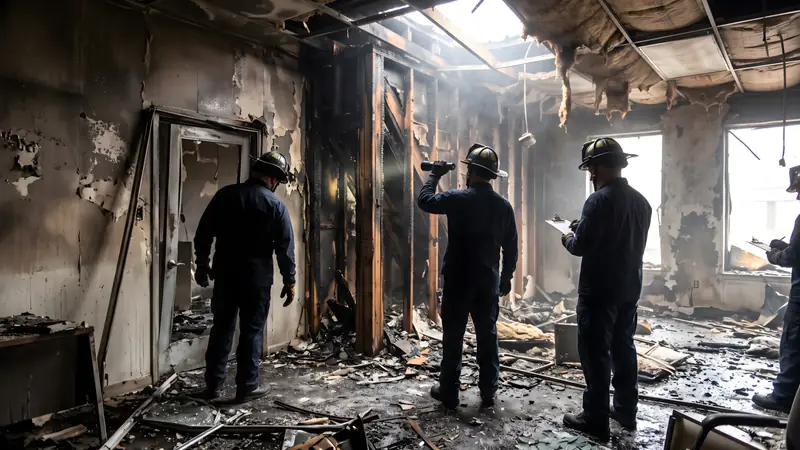
That is why the debris field has to be documented before anything is collected. The position, distance, and direction of fragments are mapped and measured. Together with the structural displacement, they point back toward the area where the gas collected and ignited.
Finding the Leak Path
Once the area of origin is narrowed down, the investigation turns to how the gas got there. The gas system is examined from the point of delivery to every appliance it serves:
- Service equipment: meters, regulators, and service lines, together with the utility
- Building piping: joints, fittings, unions, and any recent alterations or repairs
- Appliance connectors: flexible connectors, which can fail from age, damage, or improper installation
- Appliance controls: gas valves, pilots, and burners on water heaters, furnaces, ranges, and dryers
- Open or uncapped lines: abandoned outlets left uncapped after an appliance was removed
Valves are documented in their as-found positions before anyone touches them. Pressure and leak testing of the system is done with the utility and all interested parties present, under an agreed protocol, so the results cannot later be attacked as one-sided. Components that need closer examination are removed, sealed, and taken to a joint laboratory inspection rather than taken apart at the scene.
Identifying the Ignition Source
A leak explains the fuel, but the cause is not complete until the ignition source is identified. Candidates are listed and tested against the evidence. They include standing pilots, burners, electrical switches, relays and motor contacts, thermostats, refrigerator compressors, and static discharge. The question for each is whether it was where the flammable mixture was, at the moment of ignition, with enough energy to ignite it.
Witness accounts often fill in that timeline. A light switched on or an appliance cycling just before the explosion can be decisive. Each account still has to be checked against the physical evidence.
Evidence That Must Be Preserved
Gas explosion scenes are unstable and often dangerous, and much of the critical evidence is small and easily lost. The key items to preserve are:
- The entire gas train: meter, regulator, piping, connectors, and appliance controls
- Appliances in the suspected area of origin, including those that appear undamaged
- LP-gas tanks and cylinders, with their valves and regulators as found
- Utility and supplier records: deliveries, odorization, service calls, and leak reports
- Records of recent work on the gas system, including permits and contractor invoices
- A mapped and photographed debris field, before collection
The steps for securing the scene and notifying interested parties are covered in detail in The First 72 Hours After a Fire or Explosion.
Post-Blast Experience on Your Side
LaRovere's explosion investigations are led at the scene by Justin Weller. His background includes bomb investigation in 13+ years of Arizona law enforcement, eight years in the fire service, and service as a hazardous materials technician. He has completed the FBI Post Blast Investigators School twice, along with large vehicle bomb crime scene investigation and terrorist bombing response training. The scene work is paired with licensed Professional Engineers who analyze the gas system, appliances, and controls. The physical evidence and the engineering are developed together and documented to the standard litigation demands.
Frequently Asked Questions
What causes a natural gas or propane explosion?
A gas explosion needs three things at the same time. Fuel gas has to leak and mix with air until the concentration falls inside its flammable range. That mixture has to be confined, usually inside a building, a room, or a void. And it has to reach an ignition source, such as a pilot light, a switch, a motor, or static discharge. A cause investigation has to explain all three: where the gas came from, why it accumulated, and what ignited it.
Is natural gas lighter or heavier than air, and why does it matter?
Natural gas is mostly methane, which is lighter than air and tends to rise. Propane is about 1.55 times as dense as air and tends to settle in low spaces. That difference shapes where leaked gas collects, where the flammable mixture formed, and what damage pattern the explosion is likely to leave. It is one of the first things an investigator considers when working back from the damage to the leak.
Why didn't anyone smell gas before the explosion?
Fuel gas is odorized with mercaptan compounds so leaks can be smelled, but odor is not a guaranteed warning. Odorant concentration can fade in LP-gas storage and transport. It can be absorbed by the walls of new steel piping, and it can be stripped from gas migrating through soil. People also differ in their ability to smell it. Whether the gas was adequately odorized is a common question in gas explosion cases.
What is the difference between a seated and a nonseated explosion?
A seated explosion leaves a localized area of severe damage, such as a crater or a ruptured vessel. That pattern is typical of a confined, highly concentrated energy release. A nonseated explosion has no single point of maximum damage, because the fuel was spread through a room or building before it ignited. Most building fuel-gas explosions are nonseated, so investigators read the overall pattern of structural damage rather than looking for a crater.
Who can be responsible for a gas explosion?
Responsibility depends on where the leak originated and why. Depending on the evidence, it can involve the gas utility or supplier, a plumber or contractor who installed or altered gas piping, or the manufacturer of an appliance, connector, regulator, or valve. It can also involve a property owner or manager responsible for maintenance. The investigation has to trace the physical evidence to a specific leak path and failure before responsibility can be assigned.

About the Author
Justin Weller brings 13+ years in Arizona law enforcement and eight years in the fire service to LaRovere's fire and explosion investigations. He has more than 1,200 documented hours of fire, explosives, and related technical training and has completed the FBI Post Blast Investigators School twice.
Read Justin's full profile →